
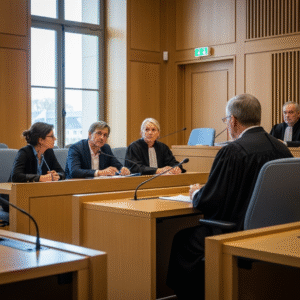
The foreclosure procedure in France is a rigorous legal process, punctuated by imperative deadlines. At the heart of this system is the orientation hearing, a pivotal moment that crystallises the debates and seals the fate of most disputes. In a landmark ruling on 21 November 2024, the Court of Cassation recently reinforced the quasi-absolute nature of this deadline, specifying the timeframe for bringing a case before the court. Understanding the scope of this rule is essential for both creditors and debtors, as any negligence at this stage can have irreparable consequences for the rest of the enforcement process.
The principle of concentrating disputes at the orientation hearing
French law, via the Code of Civil Enforcement Procedures (CPCE), has introduced the principle of concentrating defences and incidental claims at the orientation hearing. The aim is clear: to purge the proceedings of all upstream disputes in order to secure the forthcoming sale, whether amicable or forced, and to set the sale price.
Article R. 311-5 of the CPCE is the keystone of this system. It stipulates that on pain of inadmissibility, which must be pronounced ex officio by the judge, no challenge or incidental application may be made after the orientation hearing. Any late application is therefore declared inadmissible. This rule applies to all parties: the seized debtor, the pursuing creditor and the registered creditors. The enforcement judge is therefore obliged to check the validity of the arguments raised and to rule on all the points in dispute at that precise moment, and not later.
The scope of the principle, clarified by the Cour de cassation
In its decision of 21 November 2024 (no. 22-12.499), the Second Civil Chamber of the Court of Cassation provided a major clarification. Previously, there had been uncertainty about the debtor's power to bring an action before the court even before the summons to the orientation hearing. The ruling puts an end to this debate: the debtor's application to the court to contest the seizure is deemed inadmissible if it is made before the orientation hearing. Challenges may be raised neither before nor after, but only during the orientation hearing. This firm stance is designed to prevent dilatory tactics and ensure a swift solution to the enforcement procedure.
This decision is in line with the sound organisation of justice, where each stage has a precise function. The orientation hearing is not a mere formality, but the place where the fate of the property seizure is truly sealed. All the analysis of the case by the debtor's lawyer must therefore be finalised by this crucial deadline, because a subsequent appeal will not allow a plea to be raised that should have been raised in the first instance.
The extent of inadmissibility: a virtually absolute purge
The scope of this inadmissibility is extremely broad. It concerns all challenges that could have been raised before the date of the hearing. This includes, for example :
- Nullity or lapse of the summons to pay in lieu of seizure of property, after publication of the summons.
- Challenging the debtor's claim in principle or in amount (e.g. statute of limitations, interest rate on an unpaid loan, request for cancellation).
- The validity of the writ of execution as a basis for prosecution, particularly in the case of consumer credit or mortgage loans.
- Disputes relating to the terms and conditions of sale, which set the upset price in particular.
- An application for the nullity of a procedural act performed prior to the hearing, on pain of nullity.
Once the referral judgment has been handed down, these grounds are purged. The debtor will no longer be able to invoke them in an attempt to have the sale or auction annulled. This rigorous approach requires constant vigilance on the part of the parties and their advisers, and current case law confirms this trend.
Rare exceptions to the inadmissibility rule
While the principle is concentration, the CPCE provides for limited exceptions to enable situations arising after the debate to be addressed. A challenge remains admissible if it arises from a subsequent fact or act. The two strict exceptions are :
- It relates to procedural documents issued after the orientation hearing. In this case, the request must be made within fifteen days of service of the disputed document, often by registered letter with acknowledgement of receipt.
- It arises from circumstances subsequent to the hearing and is such as to prevent the seizure from continuing. These are new events that affect the very basis of the execution (for example, payment in full of the debt, which is grounds for cancelling the proceedings). This also includes issues relating to the proposed distribution of the sale price.
Apart from these cases, no other dispute may be raised. A request to accelerate a loan, for example, would be deemed inadmissible. Current legal developments, in particular the provisions of article R322 of the CPCE, confirm this rigour.
Practical consequences and strategies to adopt
For the seized debtor
For the person whose property is seized, the message is clear: the orientation hearing is the last opportunity to contest. It is essential to act well in advance of this date. A lawyer is essential to carry out a complete analysis of the case, from the validity of the bank's loan agreement to the breakdown of the outstanding debt, including the legality of each act served by the commissioner of justice (formerly a bailiff). From the service of the initial summons to the preparation of the sale, the commissaire de justice is a key player. The deadline for taking action is short, and failure to act can have serious consequences, especially if the property is the owner's principal residence.
For the pursuing creditor
For the pursuing creditor (often a credit institution), the referral judgement is a decisive step in securing its approach. Once this stage has been passed without dispute or with objections rejected, the path to a compulsory sale or the finalisation of an amicable sale is considerably smoothed. This allows the seller to incur the costs associated with advertising the sale (via the land registry) with greater visibility, to set the amount of the upset price for the auction and to reduce the risk of subsequent cancellation of the procedure undertaken to pay the debt.
Conclusion: the orientation hearing, a cornerstone of the foreclosure process
Ultimately, the Court of Cassation's rigorous stance on the timing of challenges to property seizures reinforces the central role of the orientation hearing. Far from being a simple stage, it is the real trial of the seizure, where all the arguments must be presented at once. This organisation of civil enforcement proceedings in France aims to strike a balance between protecting the debtor's right to defend himself and the creditor's need to obtain an effective solution for recovering his debt. To navigate this complex procedure and find a suitable solution, the assistance of an expert is more than a recommendation, it is a necessity. If you are faced with such a situation, it is crucial to consult a lawyer specialising in property seizures for fast access to quality information. Thank you for reading this topical content.




 EN
EN  FR
FR